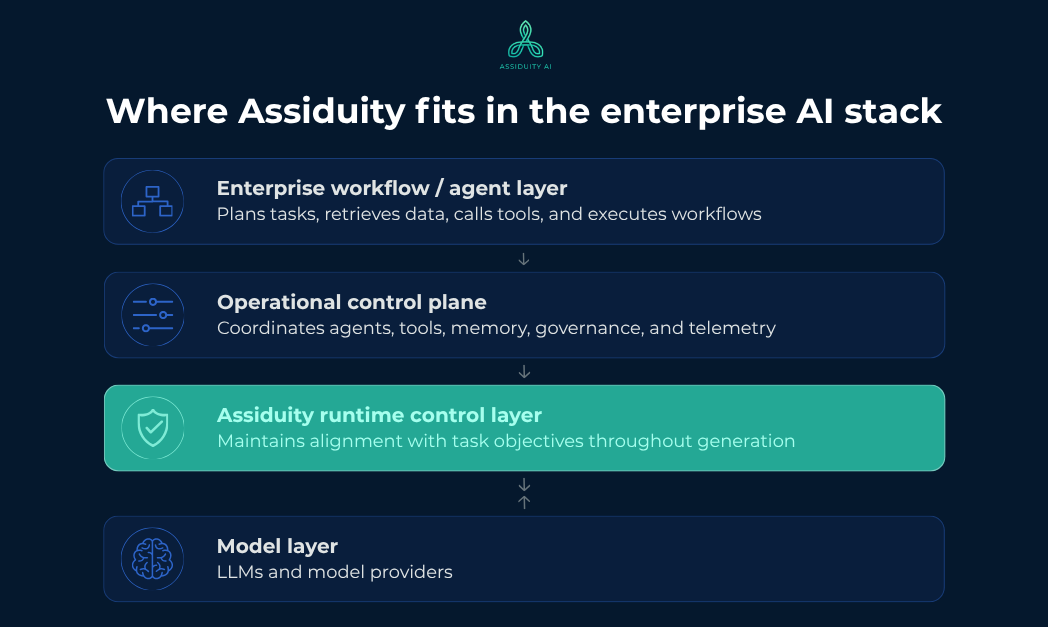
Operational control planes coordinate agents, tools, telemetry, and workflows. Assiduity operates inside the generation path to preserve alignment during generation.
Enterprise AI is entering a new phase. The market has largely moved past the question of whether a model can answer a question or summarize a document. The focus now is on systems that can carry out longer, more complex workflows: retrieving information, reasoning across context, calling tools, and taking action across business systems.
That shift makes control architecture unavoidable. When AI systems begin to act, rather than simply respond, organizations need structure that governs how those systems operate. This is why the idea of a control plane for enterprise AI is gaining real traction.
But control is not one thing. As the market matures, the distinction between different kinds of control is going to matter more.
The Operational Control Plane
As enterprises shift to agentic AI, they need infrastructure that coordinates agents across tools, workflows, and data sources. Operational control planes provide this.
An operational control plane handles the connective tissue of enterprise AI deployment: tool access, orchestration, telemetry, memory and context management, governance policies, and integration with enterprise systems. In complex environments including IT operations, security, network monitoring, and incident response, this layer is essential. Without it, agents have no reliable way to reach the right systems, preserve context across steps, or operate within defined boundaries.
The questions an operational control plane is designed to answer include:
- Can the agent access the right systems and tools?
- Can it coordinate across multiple domains?
- Can it preserve context and memory across a workflow?
- Can it act within governed boundaries?
These are the right questions to ask when deploying AI in enterprise environments. Operational control planes are a necessary part of the stack, and the market is right to take them seriously.
But they do not address the full problem.
A Different Control Problem
Even when an agent has the right tools, sufficient context, and a well-orchestrated workflow, the model still has to produce the work. That is where a different kind of reliability challenge begins.
The question an operational control plane is not designed to answer is: Does the model stay aligned with the task while it is generating?
This is not a small distinction. Long, high-stakes workflows fail not only because an agent lacks the right tools or cannot access the right systems. They fail because generation itself can drift from the objective.
The output may remain fluent, structured, and confident throughout. The formatting may look correct. The language may sound authoritative. And yet the model may have gradually shifted away from the task it was given, omitting required steps, compressing parts of the reasoning, softening a constraint, or reinterpreting the objective as generation unfolds.
In this context, the semantic contract is the set of task requirements, constraints, and completion standards the output is expected to satisfy.
Consider what this looks like in practice. A compliance review that thoroughly covers the first forty clauses and then becomes less rigorous near the end is not a successful review. A policy analysis that starts with the right framework and then quietly drifts from it is incomplete. A contract summary that looks accurate at a glance but has gradually softened key obligations is a liability, not a deliverable.
These are not hallucination failures in the conventional sense. The model has not necessarily invented something false. It has drifted from the semantic contract it was supposed to satisfy. And because the output looks coherent, the failure may not be visible until something downstream goes wrong.
Runtime Generation Control
This failure mode is distinct from anything that orchestration, observability, or governance can solve on their own.
Observability can show you what happened. Governance can define what the agent is allowed to do. Orchestration can determine which tools and systems the agent can reach. Post-hoc evaluation can flag problems after the fact. These are all valuable. But none of them keep the model aligned with the objective during generation.
That requires a different layer: runtime generation control.
Runtime control is not about monitoring what the agent does across a workflow. It is about maintaining alignment between the task, the semantic requirements, and the output that the model actually produces. The control surface is inside the generation path itself.
This becomes more important as enterprise AI moves into document-heavy, high-accountability settings such as legal review, regulatory compliance, administrative workflows, and operational reporting. In those contexts, the cost of subtle drift is high, and failures are often invisible until they are already embedded in the output.
Real reliability cannot depend entirely on review after the fact. By the time a long output is complete, the drift has already happened.
Where Assiduity Fits
The enterprise AI stack has several control layers, and they are not interchangeable. The workflow layer coordinates actions across tools and domains. The governance layer defines permissions, policies, and oversight. The observability layer monitors telemetry and behavior over time. And the runtime generation layer is where the model either stays aligned with the objective or begins to drift.
Each layer matters. Each answers different questions. Confusing them is an easy mistake to make early in a market, but it becomes more costly as deployment expands into high-stakes use cases.
Operational control planes are an important part of what makes enterprise AI deployable at scale. They help agents coordinate across tools, systems, telemetry, memory, and workflows. But as AI moves into longer and higher-stakes work, the next question the market will have to answer is whether the generation path itself is controlled.
That is the problem Assiduity is built for: runtime control that helps generative systems stay aligned while the work is being produced, not only after the output is complete.
The Right Distinction
The enterprise AI stack has several control layers, and they are not interchangeable. The workflow layer coordinates actions across tools and domains. The governance layer defines permissions, policies, and oversight. The observability layer monitors telemetry and behavior over time. And the runtime generation layer is where the model either stays aligned with the objective or begins to drift.
Each layer matters. Each answers different questions. Confusing them is an easy mistake to make early in a market, but it becomes more costly as deployment expands into high-stakes use cases.
Operational control planes are an important part of what makes enterprise AI deployable at scale. They help agents coordinate across tools, systems, telemetry, memory, and workflows. But as AI moves into longer and higher-stakes work, the next question the market will have to answer is whether the generation path itself is controlled.
That is the problem Assiduity is built for: runtime control that helps generative systems stay aligned while the work is being produced, not after the output is complete.