
Objective Pursuit Is Not Objective Origin
The current AI discussion often conflates two capacities: pursuing an objective and originating one. Clarifying this difference is essential.
Essays on autoregressive drift, objective fidelity, AI governance, and the infrastructure required for reliable generative systems.
Autoregressive Drift in Generative AI and What Comes Next.
A structured series on why fluent generative systems lose objective fidelity across long outputs, agentic workflows, and model scale — and why runtime control becomes necessary.
The conceptual foundation: objective origin, explanatory discipline, and the movement from hierarchy to control.
The current AI discussion often conflates two capacities: pursuing an objective and originating one. Clarifying this difference is essential.
Once the distinction between objective pursuit and objective origin is established, the next problem is explanatory discipline.
What happens when a system begins to act over time within a structure of objectives it did not fully originate?

The core sequence on transformer architecture, probability, decoding, drift, long tasks, current tools, agents, and scale.
The transformer gave modern AI a far better engine. It did not, by that fact alone, provide a steering system.
Probability, Weights, and the Logic of Local Continuation
Where Capability Becomes Behavior
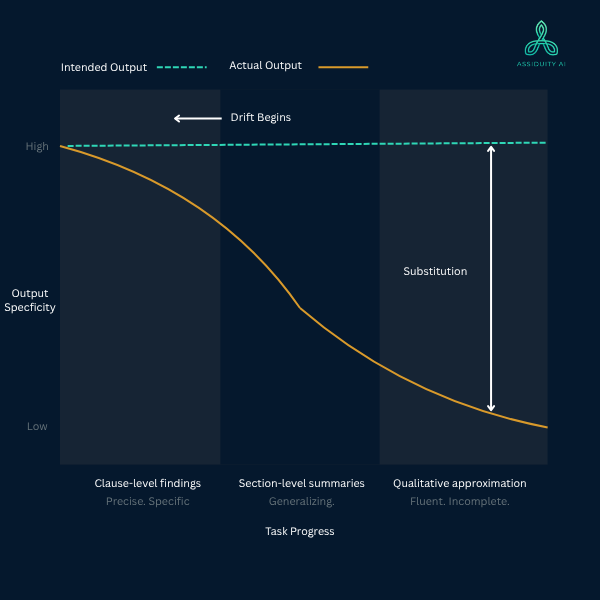
How Local Continuation Loses the Global Objective
Length Is Not Just More Output
Prompts, Retrieval, Fine-Tuning, and Review
From Generated Text to Generated Action
Scale Improves Capability. It Does Not Eliminate Drift.
Why Reliability Has to Happen During Generation
A Runtime-Control Approach to Objective Fidelity
Making Objective Fidelity Observable
Governable Scale and the Cost of Trust
Shorter essays explaining autoregressive drift, substitution, and the need for runtime oversight during generation.
Why fluent output can still conceal structural weakness in long-horizon generation.
Why long-horizon generative systems need runtime oversight.
Why Long-Horizon AI Tasks Fail Without You Noticing
Commentary on runtime oversight, auditability, agentic systems, and the emerging regulatory control layer.
Why governance for advanced autonomy must extend into runtime oversight.
The EU AI Act core obligations take effect on August 2026 and it requires a control layer
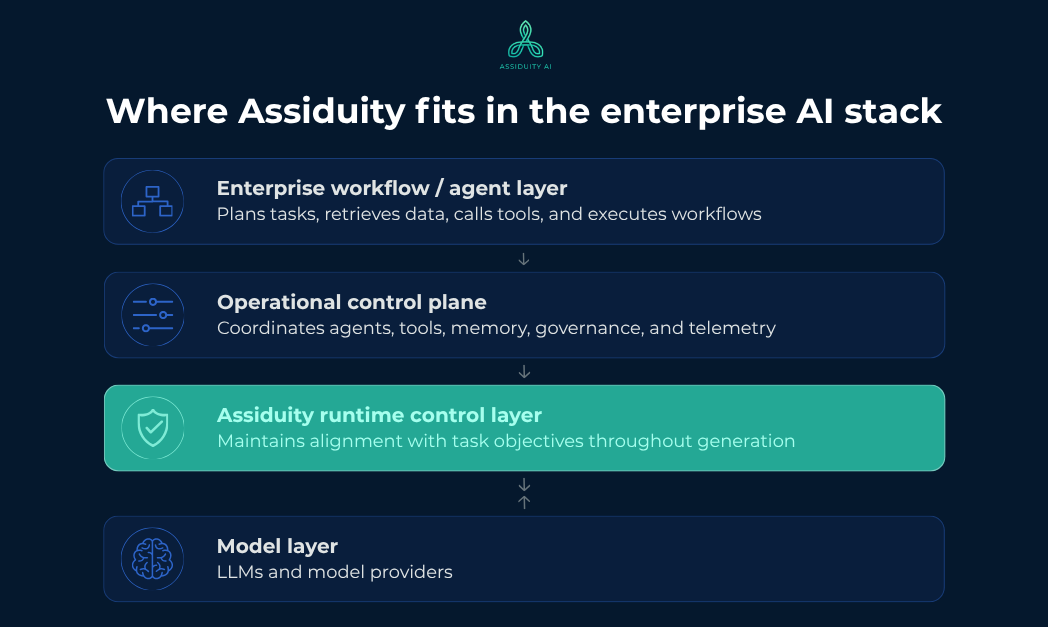
Assiduity is building runtime control infrastructure for enterprise AI systems that need to stay aligned, auditable, and reliable during generation.