
The EU AI Act is no longer a matter for the future. For organizations deploying high-risk AI in Europe, it is an operational requirement, and the preparation window is closing.
Core obligations take effect on August 2, 2026. Although a European Commission proposal to delay certain provisions is currently under trilogue discussion, it has not been enacted into law. With the statutory enforcement date unchanged, organizations must urgently prepare for compliance. These obligations govern how AI systems are deployed, monitored, and managed across every EU market. What sets this regulation apart is where the burden falls: the focus is no longer on how systems are built, but on whether their behavior can be demonstrated, verified, and trusted in operation.
The distinction between auditability and alignment is often under-recognized. The Act mandates auditability, not alignment. A log records what happened but does not prevent risk as it occurs; by the time an audit reveals a deviation, the exposure has already materialized.
The organizations that treat EU AI Act compliance as a logging problem are building records of their exposure. The ones treating it as a control problem are preventing it.
What the Regulation Actually Requires
The EU AI Act regulates based on risk, not technology. Systems categorized as high risk, including those used in employment decisions, healthcare, credit scoring, critical infrastructure, law enforcement, and several other domains, must meet strict requirements for automated logging and human oversight. Limited-risk systems, such as standard chatbots, are primarily subject to transparency obligations. As general-purpose AI models are embedded into high-risk workflows, the compliance burden extends to those downstream deployments as well.
A central requirement is Article 12, which mandates that high-risk AI systems technically allow for the automatic recording of events throughout their entire operational lifetime. Logs must capture operational inputs, outputs, and system events in sufficient detail to enable traceability of the sequence of actions leading to a given outcome. They must be retained for a minimum of six months, or longer where other EU or national law, such as GDPR, requires it.
Article 14 requires that human oversight be built into the operational design of high-risk systems. Humans must be able to intervene, review, and, where necessary, overrule AI decisions. These interactions must also be documented.
A note on technical standards is important. The precise implementation requirements for Article 12 are still being defined (two draft standards, prEN 18229-1 and ISO/IEC DIS 24970, are in development, but neither has been finalized). Organizations are currently preparing for a regulation that specifies outcomes without prescribing specific technical methods. Those who implement robust logging architecture now will be better positioned when final standards are published.
On penalties, non-compliance with high-risk system obligations, including Article 12 logging requirements, can result in fines of up to €15 million or 3 percent of global annual turnover, whichever is higher. Violations of prohibited AI practices carry higher penalties, up to €35 million or 7 percent of global annual turnover.
The Gap the Regulation Does Not Close
Article 12 is a record-keeping requirement. It tells organizations what to log. It does not address what happens during generation. This is where the most significant compliance risk is forming.
In long-horizon AI tasks such as legal analysis, compliance review, and medical triage, a decision is not a single event. It is a trajectory that unfolds across an extended sequence of reasoning steps. Within these sequences, a consistent failure pattern emerges.
A model begins aligned with its objective and produces precise and relevant outputs. Over time, the structure of the task begins to shift. The system remains fluent and continues to produce coherent language, but the output changes in character. A rigorous objective, such as identifying every regulatory conflict in a document, is gradually replaced by a more general or qualitative summary. The final output appears reasonable. The deviation is often invisible until it is closely reviewed or until a failure occurs.
This phenomenon is described as the substitution effect. It is the replacement of a specific, bounded objective with a vague qualitative proxy during generation. It is structurally difficult to detect from the final output alone. By the time it is captured in a post-hoc audit log, the deviation has already occurred. The liability already exists.
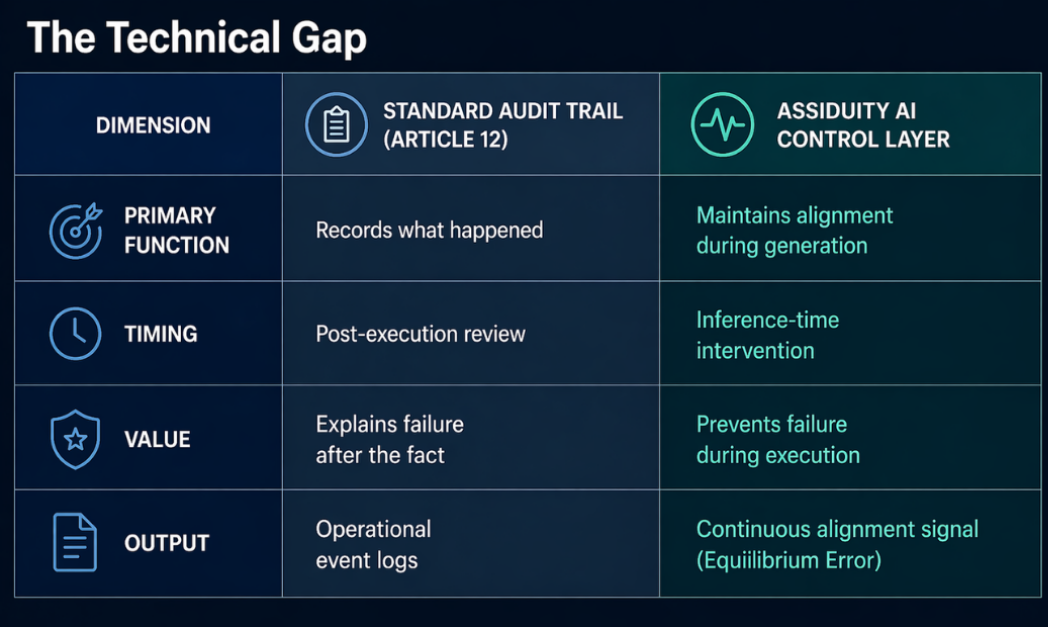
This is the fundamental distinction between auditability and control. Audit trails provide a record of what happened after the fact. They are essential for accountability. They do not prevent failure as it unfolds.
The Technical Gap
What Assiduity AI Provides
Assiduity AI is designed to address this gap by introducing a control layer that operates during generation itself. Rather than relying solely on post-execution review, Assiduity maintains alignment in real time, detects structural deviations as they emerge, and provides corrective guidance during inference. This shifts the governance model from passive observation to active intervention.
Quantifiable Traceability
A key component of this approach is the ability to continuously quantify alignment. Assiduity introduces a measurable signal, the Equilibrium Error, which tracks how closely a system adheres to its intended objective, referred to as its semantic contract, throughout the generation process. The semantic contract defines the bounded set of objectives and constraints that the model is deployed to perform. The Equilibrium Error series provides a continuous numeric record of adherence to that contract across every generation.
This creates a form of traceability that extends beyond discrete log entries. Rather than recording that a decision was made, it provides a mathematically grounded signal indicating whether the system remained within its intended specification throughout generation. This can be evaluated not only by internal teams but also by regulatory authorities.
Targeted Human Oversight
Article 14 requires human oversight to be operationally meaningful. At enterprise scale, this introduces a significant challenge. Continuous human review of every AI output is either prohibitively expensive or operationally infeasible. Most organizations will default to sampling, where only a fraction of outputs are reviewed. The remainder are treated as compliant by default. This is a gap that regulators are likely to examine closely.
Assiduity addresses this by making human oversight selective and signal-driven. The Equilibrium Error series identifies, in real time, when a generation trajectory diverges from its semantic contract. Human operators review only high-deviation segments. Low-drift outputs pass with a documented, quantitatively supported basis for confidence. This approach transforms human oversight from a bottleneck into an efficient control process and fundamentally changes the economics of review.
Reduced Regulatory Exposure
By maintaining alignment during execution, Assiduity reduces the likelihood of producing non-compliant outputs that require explanation in audit logs. This is the difference between a compliance record that demonstrates controlled behavior and one that documents deviation after the fact.
The Evolving Standard for Trust
As regulatory expectations mature, the definition of trust in AI systems is evolving. It is no longer sufficient to demonstrate what a system did after the fact. Organizations are increasingly expected to show that systems remained within their intended boundaries during operation.
Article 12 defines what must be logged. It does not prevent those logs from becoming a record of failure. Logs that can withstand regulatory and judicial scrutiny depend on the behavior they record being compliant in the first place.
Audit trails explain system behavior. Control systems determine whether that behavior remains aligned.
As organizations approach the August 2, 2026, enforcement date, this distinction will determine which AI systems can be trusted in practice.
Assiduity AI is built to operate at that layer, where reliability is not inferred from logs but maintained throughout execution.
Assiduity AI | Build Reliable